
Since we won Maruti Suzuki’s Nurture Cohort 4, one question keeps coming up, from investors, founders and plant heads alike:
“So you’re a voice AI company, like Sarvam or Navana?”
It’s a fair question. We build voice agents, and we’re proud of them. But the answer is no, and the reason says a lot about where agentic AI in India is going next
Indian voice AI has had a remarkable two years
Let’s start with credit where it’s due.
Sarvam AI has built a full sovereign stack for Indian languages: its own large language models, speech recognition across 22 languages, text-to-speech, and voice agents that companies like SBI Life and Tata Capital use to talk to customers at scale. It even offers on-prem and edge deployment, and a vision model for reading documents.
Navana.ai has focused tightly on enterprise voice, with speech models for 12 Indian languages and 45 dialects. It reports more than 100 million voice-AI minutes for lenders like Bajaj Finserv and Ujjivan Small Finance Bank, and raised a Series A in September 2026.
Together with many others, they’ve made a once-impossible thing routine: a machine that holds a natural, multilingual phone conversation with an Indian customer.
That’s exactly why we say voice was never the hard part. It’s becoming infrastructure.
What wakes the agent up?
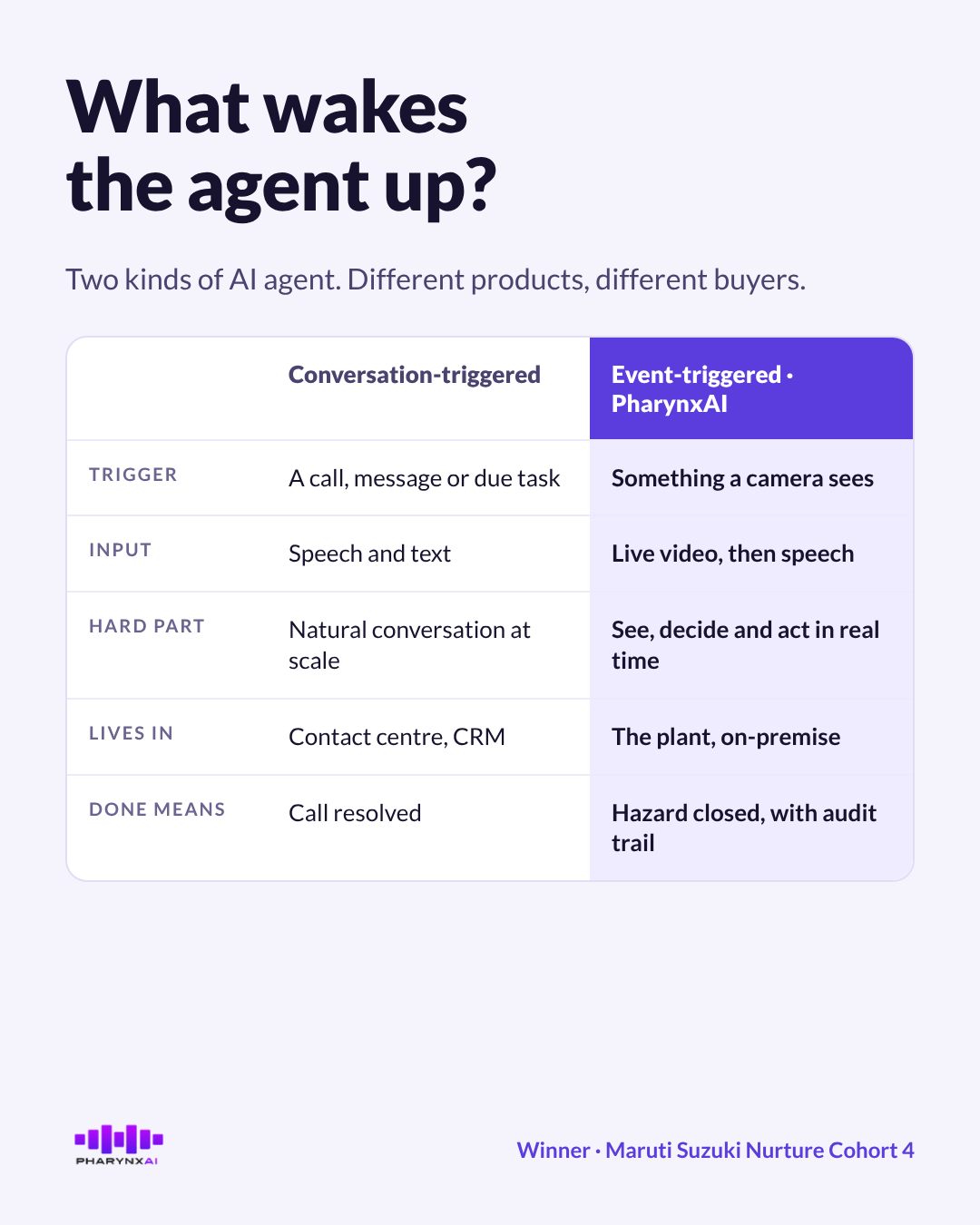
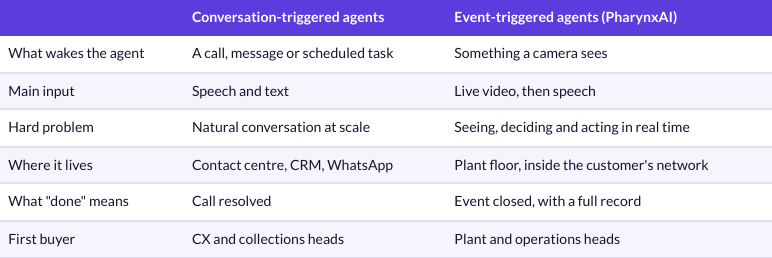
Here’s the question that separates categories: what triggers the agent?
For conversation-first platforms, the trigger is a conversation. A customer calls. An EMI is overdue. A lead fills in a form. A policy is up for renewal. The agent’s job is to talk well, and the trigger arrives neatly packaged.
On a factory floor, nobody calls.
Someone enters a zone that needs protective gear. A drip appears near a fuel line. A wisp of smoke shows up on one camera among hundreds, at two in the morning.
There is no ticket, no call, no form. The event happens in the physical world, and the only witness is a camera.
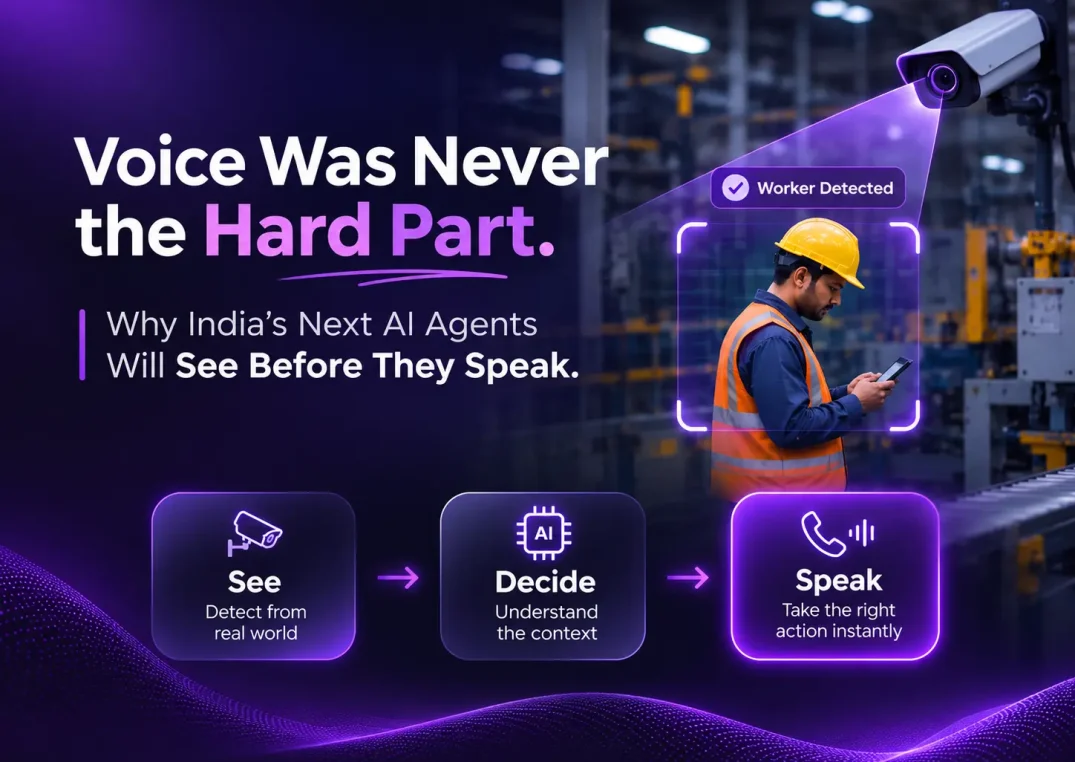
So an agent for the plant floor has to see first. It has to know the zone, the shift and the rules; decide this needs action and is not a false alarm; and then act, by calling the right person, in their language, in seconds.
Then it has to show what happened, with a short clip and a full record.
That’s not a voice product with a camera bolted on. It’s a different product.
Why we think this matters for India
The cameras are already there. Indian plants, warehouses, yards and campuses already have extensive camera networks. Turning that video into real-time understanding and action is the next leap. An agent that runs on existing cameras needs no new hardware, so pilots start in weeks, not budget cycles.
Operations leaders buy outcomes. Faster response, smoother operations and a complete record of what happened are things plant and operations heads already budget for. Agents that deliver them are a line item, not an experiment.
Industrial data doesn’t leave the building. Plant video is sensitive. Our platform runs fully on-premise, on an edge GPU server inside the site’s network, with our own vision and conversational models, built with IIT Madras Research Park. No cloud APIs, no data leaving the site.
Voice is the last mile, and it’s where the value lands. A dashboard alert can be missed. A phone call in Hindi to the right person rarely is. That’s why vision alone isn’t enough either: seeing without acting is just a recording.
What we presented at the Grand Finale
At the Nurture Grand Finale, we didn’t pitch the best voice. We pitched the loop: existing cameras, an on prem edge server, vision agents applying each zone’s rules, instant escalation by voice, dashboard and mobile, and a complete record.
The same platform extends across industry: zone access, protective gear, leaks, smoke and process steps. Adding a use case means adding a rule, not starting a new project.
Where this goes
We don’t think the future is voice companies versus vision companies. We think it’s agents that use every sense they need: seeing on the floor, speaking to the people who must act, and working across channels. That’s what our Sync platform is built to do.
Conversation-first platforms will keep getting better at talking. We’re building agents that know when to talk, because they saw something worth talking about.
Voice was never the hard part. Knowing when to speak is.