You’ve brought a potential customer to the checkout page, which is a huge win.
They’ve found a product they like, added it to their cart, and are ready to buy. But then… they leave.
This is a common and frustrating problem for many D2C brands. In fact, on average, around 70% of all online shopping carts are abandoned. That’s seven out of every ten potential customers walking away right before making a purchase.
What’s going on here? It’s not that they’ve lost interest.
Instead, they’ve likely encountered a hurdle; an unexpected cost, a confusing form, or a security concern. But aren’t all these fixable problems? By addressing the root causes of cart abandonment, you can reclaim lost revenue and boost your bottom line without spending more on customer acquisition.
This is critical because in today’s market, your Customer Acquisition Cost (CAC) is constantly rising. This means every customer you lose at the checkout is a significant investment that didn’t pay off. Fixing this isn’t just about recovering sales; it’s about making your existing marketing spend more efficient.
Here are seven fixes to help you recover abandoned carts and turn “almost buyers” into loyal customers.
1. Simplify the checkout process
Imagine you’re standing in a long queue at a physical store, and every few feet, you’re asked to fill out a different form. You’d probably get frustrated and leave. The same goes for online checkout.
When your checkout flow is clunky and filled with unnecessary steps, it creates friction that interrupts the process and leads to abandonment.
A good next step is to audit your current checkout process. Look for ways to streamline it and prioritize the user experience over internal system needs.
Reduce steps: Consider a single-page checkout or a progressive flow that guides customers through one section at a time.
Offer a guest checkout option: Don’t force new customers to create an account. Let them complete their purchase quickly, then give them the option to create an account later.
Use autofill: Implement smart forms with APIs and predictive inputs to help users, especially on mobile, to fill out their information faster and with fewer errors.
By making your checkout simple and intuitive, you can see a 15–25% increase in conversion rates without any extra marketing spend.
2. Be transparent with pricing
There’s nothing more jarring for a customer than getting to the final step of checkout and seeing a sudden jump in the total price. When unexpected shipping fees, taxes, or other charges pop up at the last minute, it can trigger a psychological response called loss aversion.
A surprise shipping fee or tax at checkout feels like a loss from this original price, and the disappointment of this unexpected cost is often powerful enough to make them abandon the purchase altogether.
To build trust and prevent this, be transparent about your pricing from the very beginning.
Display all costs early: Show shipping costs and taxes as early in the shopping journey as possible.
Motivate with free shipping: Use a dynamic indicator that shows customers how close they are to the free shipping threshold, encouraging them to add more items to their cart.
Use bundled pricing: When possible, integrate fees into the product price to simplify the checkout experience.
Being upfront about costs builds trust, which in turn leads to higher customer retention and strengthens your brand equity.
3. Optimize for mobile-first
Most of your website traffic likely comes from mobile devices, yet many checkout pages are still designed for desktop. A checkout process that’s difficult to navigate on a small screen, with tiny buttons and slow load times, is a guaranteed way to lose customers.
A mobile-first revenue architecture helps by maximizing conversions from your largest traffic source. It ensures the checkout experience is fast, easy to navigate, and optimized for small screens, which directly reduces abandonment rates and increases sales.
Design for thumbs: Optimize the layout and button placement for easy use on a phone.
Trigger the right keyboards: Automatically show the numeric keyboard for phone number fields and the email keyboard for email fields.
Speed up your site: Use image compression, caching, and lazy loading to ensure your checkout page loads quickly on any device.
4. Diversify your payment options
Customers have different preferences for how they pay. If you only offer a few options, you’re essentially putting up a roadblock for anyone who wants to use a different method. This is especially true for international customers or those who prefer modern payment solutions.
A strategic payment method portfolio can significantly increase your customer base.
Offer a variety of options: Accept major credit cards, popular digital wallets like Apple Pay and Google Pay, and Buy Now, Pay Later (BNPL) services like Klarna or Affirm.
Enable one-click checkout: For returning customers, store their payment information securely to make repeat purchases effortless.
Customize based on location: Tailor your payment options to the customer’s region and currency to provide a localized experience.
Each new payment method you add opens the door to a new segment of customers. By enabling a friction-free purchase, you increase the likelihood of repeat business. This makes a big difference in the overall Lifetime Value (LTV) of your customer base.
5. Build trust with clear signals
New customers may hesitate to buy if they’re not confident in your store’s security. They’re worried about their financial data and what will happen if they need to return an item. A lack of visible trust signals can create enough doubt to send them away.
You can proactively reduce this perceived risk by integrating trust signals directly into your checkout process.
Show security badges: Prominently display security seals and badges from trusted providers like Norton or McAfee to reassure customers that their information is safe.
Display social proof: Use real-time notifications about recent purchases or display a product’s star rating to show that other people are buying and enjoying your products.
Clarify policies: Clearly state your return and refund policies right in the checkout flow to ease anxiety and show that you stand behind your products.
Use reassuring language: Add simple, reassuring messages like “Secure Checkout” or “No Hidden Fees” to microcopy.
When customers feel safe and secure, they are much more likely to complete their purchase and return to your store in the future.
6. Use behavioral triggers strategically
Some customers don’t abandon their carts because of a problem; they simply get distracted or decide to “think about it later.” This is where you can use behavioral economics to gently nudge them toward a purchase. The key is to create a sense of urgency without being pushy or inauthentic.
Highlight scarcity: Use real-time alerts about low stock or a limited-time sale to motivate a quicker decision.
Offer authentic, time-sensitive deals: Provide a special discount that is genuinely limited in time, making the offer feel more valuable.
Personalize triggers: Tailor these messages based on the customer’s browsing history or the items in their cart.
When urgency feels authentic and relevant, it can effectively turn a “maybe later” into a “buy now,” converting more of the valuable traffic you’ve already paid for.
7. Automate cart recovery
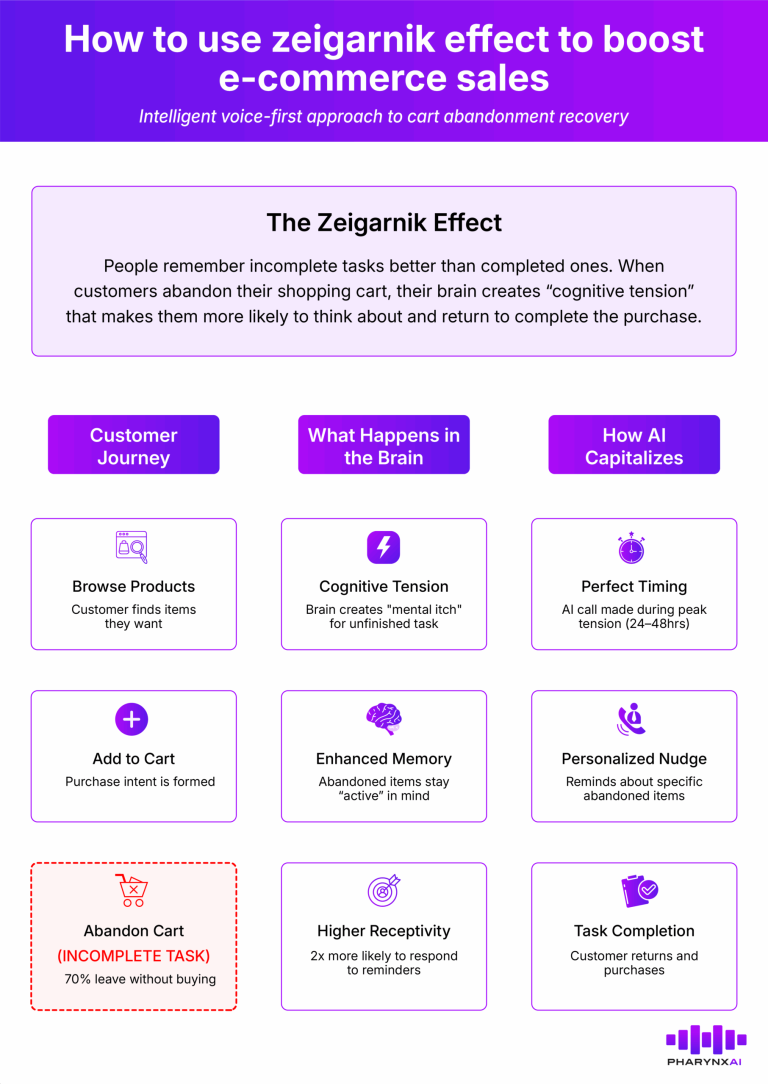
An abandoned cart is a pause in the customer journey. You can use the Zeigarnik Effect, a psychological principle that says people are more likely to remember and want to complete unfinished tasks, to your advantage. Your brand can close this “open loop” for the customer.
Don’t just rely on a single, generic follow-up email. Instead, create a comprehensive and automated recovery plan.
Use AI for high-value carts: For high-ticket items, consider using AI-driven voice calls to proactively engage with the customer. This can help you answer specific questions, overcome objections in real-time, and guide them to a successful purchase. – Increases conversion rates by providing immediate, personalized assistance. – Builds trust through natural, human-like conversations. – Reduces cart abandonment by addressing concerns at the decision-making stage.
Use a multi-channel approach: Send personalized follow-ups through email, SMS, push notifications, and targeted ads to reach the customer wherever they are.
Tailor your messaging: The messages should be contextual and specific to what’s in their cart. For example, include a picture of the item and remind them of its benefits.
How to use Zeigarnik Effect to boost e-commerce sales
Closing the loop
Cart abandonment is caused by frictionin the userjourney.
These users showed intent. They found what they wanted, moved through your funnel, and then hit a point where the experience didn’t hold up.
In today’s high-CAC environment, letting that happen is lost revenue you’ve already paid to earn. Improving checkout is all about removing blockers, reinforcing trust, and making the path to purchase feel effortless.
Because growth doesn’t always come from more traffic; it often comes from better systems that convert the traffic you already have.
And that starts by closing the gap for users who are already 90% ready to buy.